
Digging through stone for hours, hoping to stumble on a diamond,d is one of the most frustrating parts of Minecraft, and that frustration is exactly why an ore finder tool has become so popular. Whether you play on Java Edition, Bedrock Edition, or on a console or phone, these tools use your world seed to show you precisely where diamonds, iron, gold, and other underground resources are hiding. This guide covers how ore finders work, the best tools to use right now, and the traditional mining methods that still hold up if you would rather earn your loot the hard way.
What Is An Ore Finder In Minecraft?
Picture this: you have been mining for forty-five minutes straight, your hunger bar is dropping, and the only thing you have found is more andesite. That frustration is exactly why an ore finder exists. It is a tool, usually a website or app, that reads your world seed and predicts the exact coordinates of ore deposits and hidden resources before you ever swing a pickaxe. Type in your seed value and your current position, and the tool hands you a list of nearby ore clusters sorted by distance.
These tools work because Minecraft worlds are not actually random. Every block placed during world generation, including every diamond and every vein of redstone, comes from a mathematical formula that uses your seed as the starting input. The same seed in the same version always produces the same world, so an ore finder simply runs that formula in reverse instead of waiting for you to stumble onto something good.
External ore finder websites give guaranteed coordinates, while in-game techniques like listening for cave sounds rely on luck and how much of the cave system happens to be carved out near you. Neither method edits your save file, which is why most players treat ore finders more like a strategy guide than a cheat code.
How Minecraft Ore Finders Actually Work?
Understanding Minecraft Seeds
Every Minecraft world starts with a seed value, a string of numbers or letters that acts like a recipe for the entire map. You can set a custom seed or let the game generate a random one, and that single value controls every mountain, river, and ore vein in the world.
How Ore Generation Is Determined?
Mojang built ore generation around something close to a seed generator that turns your seed into chunk coordinates for every block. Diamonds and other mineral deposits are not scattered evenly. They follow probability curves tied to depth, and an ore finder reads this seed mapping logic to predict where those spikes land.
Why Seed Accuracy Matters?
Type your seed wrong by even one digit, and the prediction falls apart, because you are technically asking about a different world. This is the single biggest reason ore finders fail, and it has nothing to do with the tool itself.
Java Vs Bedrock World Generation Differences
Minecraft Java Edition and Minecraft Bedrock Edition share most resource generation rules since the Caves and Cliffs update, but Bedrock uses a different random number algorithm internally. A seed typed into a Java-only tool will not match Bedrock Console Edition, Bedrock Mobile Edition, or Windows Edition, so always confirm your tool supports the edition you play.
Best Ore Finder Minecraft Tools To Use
Not every Minecraft ore finder is built the same, but a few have proven reliable for years.
Chunkbase Ore Finder
Chunkbase is the tool most experienced players reach for first, earned over more than a decade of steady updates. Type in your seed, pick your version, and its interactive map highlights diamonds and every other resource layer on a rendered version of your world. It supports both Java Edition and Bedrock Edition.
Seed Map Tools
Several Seed Map alternatives work the same basic way, reading your seed value and rendering a navigable map of biomes, structures, and underground resources. Many load faster on slower devices, though some trail behind in supporting the newest version right away.
Universal Minecraft Editors
Universal Minecraft Editor and similar programs take a more advanced approach, letting you open your actual Bedrock save file and inspect chunk coordinates directly. This is overkill for casual players, but useful for server admins troubleshooting a corrupted world.
Mobile Friendly Ore Finder Options
If you mainly play on a phone, look for an ore finder with a responsive, mobile-friendly layout instead of a desktop tool you have to pinch and zoom through. Most major seed mapping sites now offer this.
Ore Finder Setup Guide
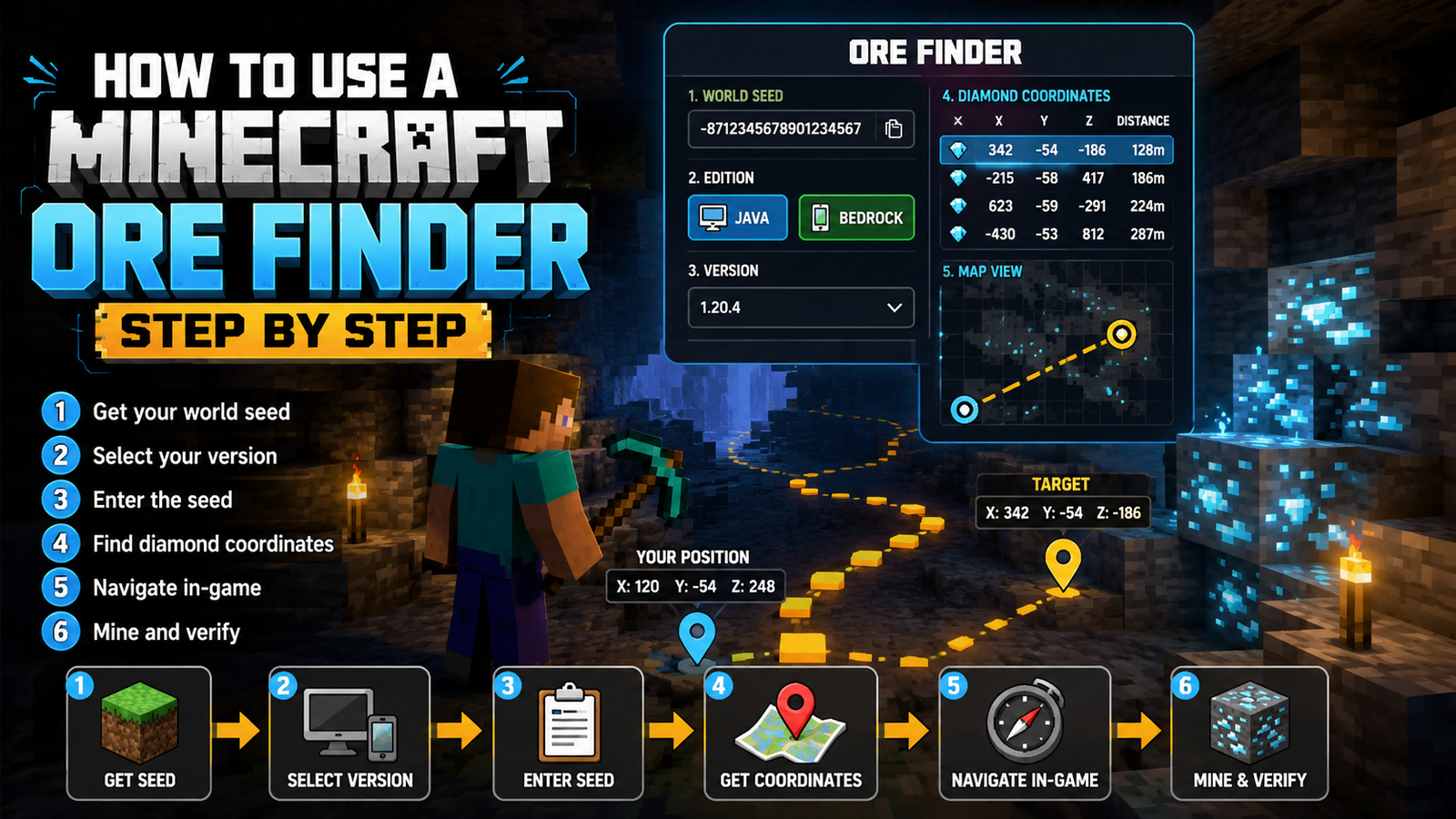
How To Use A Minecraft Ore Finder Step By Step?
Using an ore finder Minecraft tool is simple once you know the order of operations.
- Find your seed. In a single-player world, open chat and type the seed command. On a server you do not own, this may require an admin to share it.
- Select your version. Choose Java Edition or Bedrock Edition, then the exact game version your world was created in, since ore generation rules have shifted over time.
- Enter the seed correctly. Copy and paste it rather than retyping, since one wrong character ruins the whole prediction.
- Locate diamond coordinates. The tool lists nearby ore clusters with X, Y, and Z positions sorted by distance.
- Navigate to the target area in-game. Use the F3 debug screen on Java or the coordinate display on Bedrock to tunnel toward the marked spot.
- Verify the ore location. Mine carefully, since vein shapes are irregular and the marker usually points to the center of a cluster, not its edge.
Minecraft Diamond Finder: The Fastest Way To Find Diamonds
Why Diamonds Are Still Valuable?
Diamonds remain the backbone of Minecraft progression because they unlock the strongest early tools, armor, and the enchanting table itself. Nothing has replaced the moment you finally hear that mining sound and see blue flecks in the stone.
Best Diamond Levels In Current Versions
Since the Caves and Cliffs overhaul, diamond ore generates between Y 16 and Y minus 64, with the heaviest concentration around Y minus 59, just above bedrock. Many miners actually prefer Y-53, since it stays close to the diamond-rich zone while avoiding the worst lava pockets.
Using A Diamond Finder Effectively
A diamond finder works like a general ore finder, but filters results to diamonds only, which saves time if that is the only resource you actually need. One thing a lot of guides skip: ore finders only predict block-based resources like diamond ore. They cannot show you loot inside buried treasure, shipwrecks, or trial chamber vaults, since those use a separate loot table system instead of fixed seed coordinates.
Avoiding Common Diamond Finder Mistakes
The most common mistake is tunneling straight toward the marker instead of working around lava pockets that the tool cannot warn you about. Bring water buckets and check what is in front of you before breaking through near the marked coordinates.
Diamond Finder Minecraft Bedrock Guide
A diamond finder Minecraft bedrock setup looks almost identical to Java, with one extra step you cannot skip.
Does Diamond Finder Work On Bedrock
Yes, but only if you select Bedrock specifically rather than leaving the tool set to Java by default. The two editions share a similar generation since the world height update, yet differ enough underneath that mixing them up gives wrong coordinates.
Finding Your Bedrock Seed
Open your world settings before loading, since the seed shows there during creation, or use the seed command in chat once inside, the same way Java players do.
Bedrock Specific Setup Instructions
Double-check that you select Bedrock Console Edition, Bedrock Mobile Edition, or Windows Edition based on where the world was originally generated, not the device you happen to be using today, since worlds get carried between platforms.
Common Bedrock Errors And Fixes
If results look completely wrong, the likely culprit is a mismatched version number, since a seed entered under the wrong label points you toward ore that does not exist in your world.
Ore Finder Minecraft Bedrock: What You Need To Know
An ore finder Minecraft Bedrock player can trust works almost the same as the Java equivalent, with a few quirks worth knowing.
Supported Bedrock Versions
Most reliable tools now support every Bedrock version going back to the original Caves and Cliffs rollout, and many cover older legacy versions too.
Accuracy Limitations
Bedrock results are just as accurate as Java results when the seed and version match, though a few older or experimental builds have generation quirks that even well-maintained tools have not fully mapped.
Console Vs Mobile Vs Windows Bedrock Differences
Console, mobile, and Windows Editions all run the same underlying Bedrock code, so a seed found on an Xbox world behaves identically on a phone or PC once the version matches.
Troubleshooting Incorrect Results
Before assuming a tool is broken, recheck the seed value, the selected edition, and the version number. Those three fields cause well over ninety percent of every reported error.
How To Find Diamonds Without An Ore Finder?
Branch Mining Strategy
Branch mining means digging a long main tunnel at your target depth, then carving side tunnels off it every three blocks, exposing the maximum stone for the least digging.
Strip Mining Methods
Strip mining uses wider, taller tunnels meant for fast horizontal travel rather than maximum ore exposure, useful once you already know roughly where resources cluster.
Cave Exploration Techniques
Natural caves expose huge amounts of stone for free, and a single ravine can reveal more ore in ten minutes than an hour of digging. Bring torches and listen for that clinking sound near lava.
Underwater Ravine Exploration
Ocean ravines that cut below sea level often expose diamond-rich layers without digging at all. Bring a water-breathing potion or turtle shell helmet, since these spots flood fast.
Ancient City Loot Opportunities
An Ancient City, found deep in deepslate biomes, sometimes holds loot chests with diamonds and enchanted gear, though reaching one safely means avoiding the Warden that patrols it.
Best Y Levels For Every Ore In Minecraft
This chart covers the block distribution every miner needs, based on current ore generation rules. Notice how diamond and redstone peak at nearly the same depth, which is why a single trip near Y minus 59 tends to be the most efficient run you can plan.
| Ore | Best Y Level | Full Range |
| Diamond | Y minus 59 | Y minus 64 to Y 16 |
| Iron, deepslate | Y 15 | Y minus 64 to Y 72 |
| Iron, mountain | Y 232 | Y 80 to Y 320 |
| Gold | Y minus 16 | Y minus 64 to Y 32, up to Y 256 in Badlands |
| Coal | Y 95 | Y 0 to Y 320 |
| Redstone | Y minus 59 | Y minus 64 to Y 16 |
| Lapis Lazuli | Y 0 | Y minus 64 to Y 64 |
| Emerald | Y 224 | Y minus 16 to Y 320, mountain biomes only |
| Copper | Y 48 | Y minus 16 to Y 112 |
| Ancient Debris | Y 15 | Y 8 to Y 119, Nether only |
Ore Finder Vs Traditional Mining: Which Is Better
Speed Comparison
There is no contest on raw speed. An ore finder turns a forty-five-minute search into a five-minute tunnel straight to the prize, since you already know where to dig.
Survival Experience Impact
Traditional mining rewards patience, and plenty of players enjoy the slow discovery of stumbling into an unexpected cave system. Using a finder skips that, a real tradeoff worth weighing.
Multiplayer Considerations
On most multiplayer servers, getting your own seed is not always possible, since owners often keep it private for balance, which limits how useful an ore finder can be.
Pros And Cons Of Each Method
Ore finders win on efficiency and predictability. Traditional mining wins on immersion and genuine map knowledge. Most experienced players blend both, exploring naturally and pulling out a finder only when they need ancient debris or a stubborn vein.
Common Ore Finder Problems And Solutions
- Seed does not match: double-check every character, since copy-pasting beats retyping every time.
- Wrong Minecraft version selected: generation changed after the Caves and Cliffs update, so an old setting breaks new results.
- Chunk coordinates are incorrect: confirm you entered your actual in-game X and Z position, not a guess.
- Bedrock accuracy issues: always select the correct platform and confirm the world was not converted from an older format.
- Multiplayer restrictions: if a server hides the seed, an ore finder simply has nothing to work with.
Tips To Find More Diamonds Faster
- Carry efficiency tools like an enchanted pickaxe to break blocks faster while branch mining.
- Use Fortune enchantments, since Fortune III can multiply a single diamond drop up to four times.
- Bring night vision potions for caves so you spend less time relighting torches.
- Mark explored tunnels with signs or wool so you never backtrack through finished sections.
- Use coordinates strategically by noting promising spots before you start digging.
- Combine ore finders with efficient mining patterns, since knowing where diamonds are still needs a smart tunnel layout to reach them safely.
Are Minecraft Ore Finders Safe And Legitimate
Security Considerations
Reputable ore finder sites never ask for your Microsoft account, Minecraft login, or payment information just to read a seed, so treat any tool requesting that as a red flag.
Are External Tools Allowed
Mojang has never banned players for using seed-based ore finders in single-player worlds, since the tools only read public seed data and never modify your save file.
Single Player Ethics
In a single-player world, there is no one to cheat against, so using an ore finder comes down entirely to your own preference for challenge versus convenience.
Server Rules You Should Check
On multiplayer servers, rules vary widely, and some communities ban any external mapping tool to keep resource hunting fair, so always read server rules first.
When Should You Use An Ore Finder
- Survival Mode worlds where you want steady resource progress without burning hours underground.
- Hardcore Mode challenges, where every minute spent searching blindly raises your risk of dying to lava or a stray creeper.
- Creative Mode projects that need exact ore blocks for a build, rather than random natural luck.
- Speedrunning preparation, since competitive speedrunners study seeds and ore locations long before the timer starts.
- Casual exploration, when you just want to relax and watch the world unfold without worrying about loot, in which case, skip the finder entirely.
Frequently Asked Questions
What Is The Best Ore Finder For Minecraft?
Chunkbase remains the most trusted option thanks to its long history of accurate updates, though several newer Seed Map tools now match its accuracy with faster load times.
Does A Diamond Finder Work In Minecraft Bedrock Edition?
Yes, as long as you select Bedrock specifically and match the correct version, since Bedrock and Java do not share identical world generation code.
Can I Use An Ore Finder Without Knowing The Seed?
Not directly. You need your world seed for any prediction to work, though in single player, you can find it instantly with the in-game seed command.
Are Minecraft Ore Finders Considered Cheating?
In single player, most players and Mojang itself treat them as a convenience tool rather than cheating, since they only read existing world data. On servers, check the rules first.
What Is The Best Y Level To Find Diamonds?
Y minus 59 currently offers the highest diamond concentration, with Y minus 53 as a slightly safer alternative still close to peak generation.
Why Is My Ore Finder Showing The Wrong Locations?
This almost always comes down to a mismatched version, a mistyped seed, or selecting Java when you actually play Bedrock, or the other way around.
Do Ore Finders Work On Multiplayer Servers?
Only if you can access the seed, which many servers keep private specifically to prevent this kind of resource hunting.
Is It Faster To Use An Ore Finder Or Traditional Mining?
An ore finder is dramatically faster for locating one specific ore, while traditional mining still wins for players who value discovery over pure speed.
Final Takeaway
An ore finder Minecraft tool will not replace the thrill of stumbling on a diamond vein by accident, but it will save you time when you need resources fast, whether for a speedrun, a Hardcore Mode world, or a busy week where every play session counts.
The real takeaway is simple: match your seed and version correctly, pick a tool that supports the edition you play, and treat the results as a smart starting point rather than a guarantee. Whether you lean on Chunkbase, a Seed Map alternative, or stick to old-fashioned branch mining, the right method is whichever one keeps you having fun underground.